Showing posts with label United Mission to Nepal. Show all posts

Monday, 14 November 2011

Children's HIV ministry

The United Mission to Nepal supports its partner Nawa Jeevan Samaj Sewa (NJSS), a Christian Society in Sunsari that cares for 19 children affected by HIV. The impact of HIV on children and their families is not a simple issue with a simple solution or quick fix. When the HIV status of the child is known to be positive, preventive therapy against common opportunistic infections is always recommended as the standard care. The implementation of Antiretroviral drugs regimens to improve and extend the lives of children infected with HIV is considered whenever accessible and feasible. Yet, this is still a neglected area due to accessibility and the complexity of adequately implementing this service.

Nevertheless, concerted efforts to make Antiretroviral therapy available for children is being explored and strengthened in Nepal. The capacity of programmess for children living with HIV to provide adequate medical attention needs is being stressed. Even where Antiretroviral therapy may not be possible, better access to treatment of opportunistic infections help prolong lives, both for children and parents with HIV.

The family carers and guardians play a significant role when fully informed about preventing and caring for medical conditions though in some districts it is still underestimated. The Nepal Government, some International NGOs and National NGOs have child protection policies that are being brought into programmess and institutions. Some Children are affected by the changes in their parent’s emotional and physical state. They may not know what is happening to the parent and they become confused and frightened. Without proper support mechanisms, when a parent dies, children experience a profound sense of loss, grief, hopelessness, fear and anxiety. The role of the church is being built up to support affected all children and adults.

Tuesday, 25 October 2011

Dashain Holidays

Dashain is the longest and the most important Hindu festival in Nepal and is celebrated late September to mid October, immediately after the monsoon season. Dashain gets many different nicknames such as Dasara, Bada Dashain, Vijaya Dashain, and Durga Puja. Dashain is the festival celebrating the god Durga's victory over demons.

Nepali Hindus celebrate Dashain holidays and many families from urban areas visit rural families and vice versa. There is a lot of shopping goes on! Nepalese families try to shop at least for the children if not for all. The Nepali Government gives bonuses to government workers as at Dashain (usually equal to one's monthly salary). Some private companies such as banks do the same. Farmers earn their bonus by selling their highly demanded agriculture and live-stock products in return for good cash. Our house help and workers also expect bonuses.

Dashain's most popular foodstuff is meat, and in order of popularity are goat, sheep, buffalo, duck, or chicken. Meat is expensive and poorer people usually can not afford it. So dashain is the time to eat lots of meat. Usually animals are bought live from the market and sacrificed at home or in temples. At home, the whole family is involved in cutting and preparing the meat that is usually eaten over the next 2 to 3 day's of feast. But some families prefer to buy the meat already prepared by the butcher.

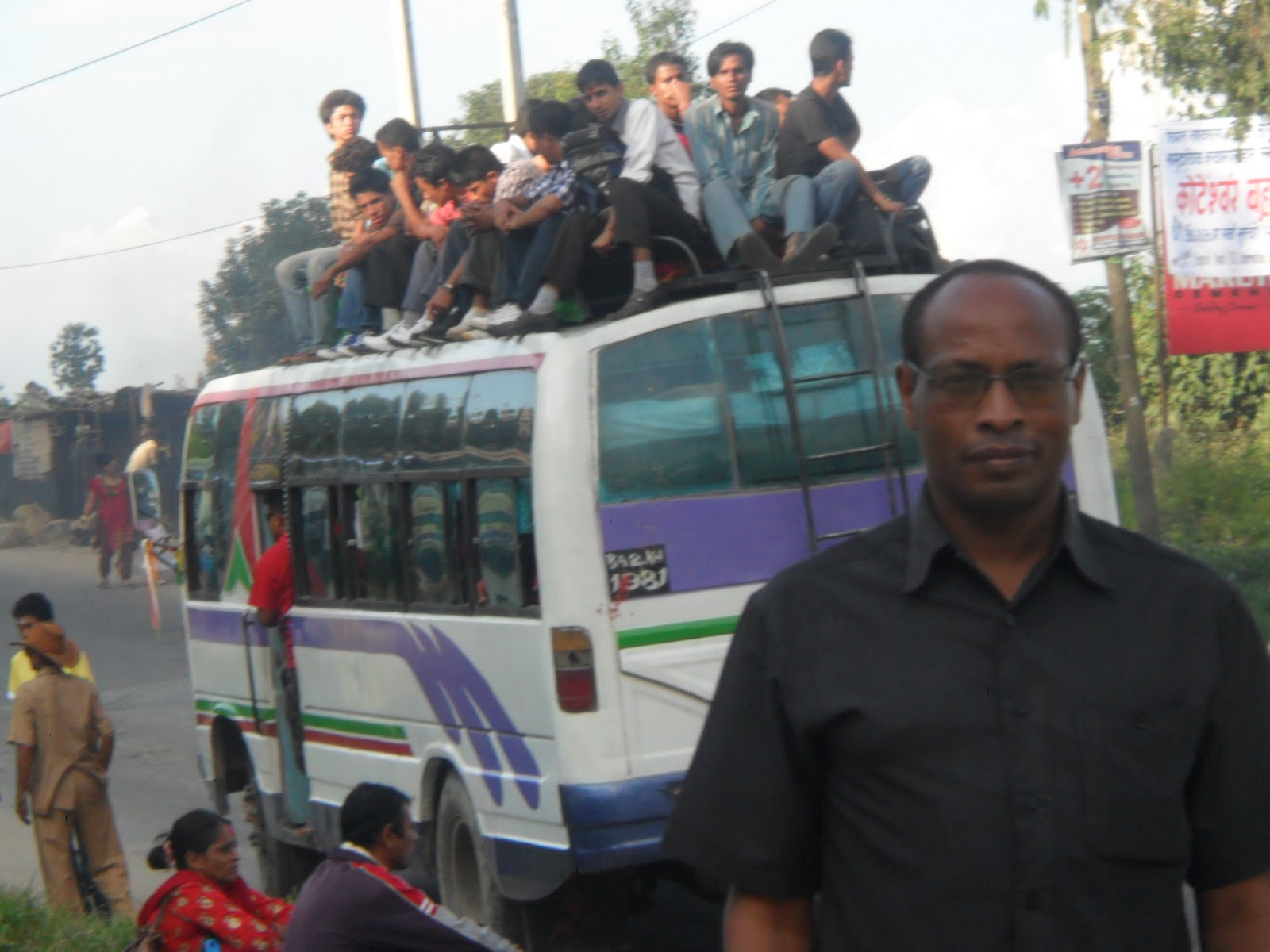
Dashain is also about family respect, so that is why scattered families come together. Cities suddenly seems to empty, more people returning to villages than people joining families in cities. During this season, people rush to book tickets on buses or planes.
Everybody tries to get home to see familiy

Children love the season also for flying kites and if you visit Kathmandu or any other city during this season, the day-sky is filled with colorful kites like shinning stars in the night!

Tika is a symbol on the forehead that the deity being worshipped is given the highest honor by the person wearing it. Getting a tika is also thought to be a blessing. The oldest person in the family begins giving Dashain tika to the youngest then the second youngest in the family and so on. There is a Hindu belief that 'faith', 'hope', 'inspiration' and 'blessings', all come alive in Dashain.

Traditionally, popular Dashain bank notes are Rupees 2, 5, 10, and 25. Therefore receiving a tika and offering money in notes is regarded as an appreciation. Everybody tries to get smaller and new notes, so banks are usually busy during the season.
The houses and temples are decorated. Walls get a new coat of paints, roads are cleaned, homes and temples are decorated with lights, villagers join together to clean or build new trails, paint their homes using red-colored mud. People clean themselves mentally too by visiting various temples and worshiping during the festival. Puja is regarded as worshiping god for peace and prosperity and are performed at the end of Dashain. Playing cards is a popular during Dashain. Usually family members play cards with each-other or with friends for money.

Village children ride on Ferris wheels, and swings built using traditional methods (ropes made from tough grass, bamboo sticks and wood). Commercial fairs and celebration events are organised in cities.

Some Christian visit their families but do not participate in eating the food sacrificed or receive the tika that shows participation in Hindu worship. Other Christians use it as an opportunity to encourage, train and coach new believers.


Pray for :

- Christian communities and leaders in Nepal

- Christian believers who face persecution from their families

- Organisations including UMN that are focused on development and anti-trafficking

- Nepal peace process and drafting of the new constitution

- Nepal security situation - there has been increase of petty criminal activities

Tuesday, 16 August 2011

Challenges for addressing HIV and AIDS in Nepal

A second national congress of people living with HIV was conducted in Kathmandu and 300 delegates attended. Most of the people living with HIV are poor and marginalized; poverty and low literacy remain the major factors that fuel the epidemic. Some could not access treatment due to stigma and living remotely. However, Nepal has made some progress as there are over 5000 people with access to Antiretroviral Therapy (ART).

One of the challenges faced in the fight against the HIV is the fact that many people do not simply know their HIV status and also many discontinue Antiretroviral drugs (ARVs) simply because the ART sites are far away from their homes. Viral load testing services are essential within six months of starting ARV treatment. Similarly drug resistance testing is also needed for those who are on ARVs for more than 3 years but such services are lacking. Livelihood support for people infected by HIV is limited and the media reports cases of discrimination against children affected by AIDS in Schools.

Please pray for the government here to ensure the rights of children affected by AIDS; formulation of a HIV bill to protect the rights of people infected and affected by AIDS; and for political commitment to respond to HIV and AIDS.

The United Mission to Nepal continues to support people infected and affected by AIDS for livelihood, treatment and care. The National Association of people living with HIV and AIDS in Nepal has been playing a crucial role ensure the right of women and children in regards to access to treatment services.

Women access information on HIV and AIDS. Some battle with effects of the epidemic and others are now educators.


Thursday, 21 April 2011

Prayers for a 'New Nepal'

UMN is partnering with the Nepali Christian Community to encourage churches to act on various social issues, and have input into building a “New Nepal”. Local facilitators are now trained to conduct workshops across the country for church leaders.

Please remember the following points in your prayer for New Nepal:

1. Local workshops with the Christian communities in Pokhara, Butwal, Damauli and Baglung next week to explore the social issues and possible Christian responses on them.

2. Local churches and Christian communities to initiate financial contributions for this movement.

3. Press Conference with local bodies next month to promote servant leadership pledge from the Christian community.
United Mission to Nepal's new logo

Friday, 18 March 2011

A snapshot of life in Nepal

UMN staff have had a whole week to learn from each other and to finalize plans for the coming year. There was sharing of good practice ranging from families infected by Aids; income-generating activities; community effort regarding peace building; rehabilitation for children with disabilities; and strengthening of work with government local agencies regarding communities.

It is encouraging to see the Government collecting statistics of children affected by armed conflict and providing community based reintegration programme. According to the National Human Rights Commission more than 500 children lost their lives, 40,000 displaced and more than 8,000 orphaned or separated from their families in the course of armed conflict since 1996.

In Nepal everyone is looking forward to Holi, a festival for colour. It is a sacred spring festival celebrated by Hindu people. Celebrations include people throwing colored powder and colored water at each other. Bonfires are lit in memory of the miraculous escape of young Prahlad when the demon Holika, sister of Hiranyakashipu, carried him into the fire. Holi is clebrated with family, friends and neighbors.

- Pray that the Government will curb organized crime as the bill is yet to be introduced in the cabinet meeting.
- Pray for my 6-day visit starting this week to far western Nepal for assessment on Migration and HIV in Doti

UMN women celebrated Women’s day with a song ‘we shall overcome some day when we shall work hand in hand!”


Monday, 14 February 2011

A step forward?

The Government of Nepal has brought in a HIV/AIDS National Policy-2011. This policy aims to secure the rights of people living with HIV and Aids, such as access to social security, in order to minimise inequality. The policy will try to provide equal opportunity in health education and other social sectors.

People living with HIV in Nepal face many challenges as most of them are from low caste and can only do very low paying jobs which can not sustain their families. Women whose husbands have passed away bear the extra burden of taking care of children.

Church leaders are mobilising their congregations to support people living with HIV and Aids to improve their living condition for instance construction of shelter for the very needy families in Sunsari District and they have already started supporting two families.

Thank you for praying for Nepal. There is now a new Prime Minister Mr.Jhala Nath Khanal. We hope that all political parties will work in unity to ensure the peace process comes to a logical end and that the new constitution will be finalized. Please pray that the Government will urgently examine pending child rights laws and expedite their endorsement.


Photo (left): Representatives from Christian organisations working on HIV from five districts of Nepal attended a two day follow-up meeting in Sunsari. It was encouraging to hear what the organisations do and their struggle to reduce stigma and discrimination.

Wednesday, 29 December 2010

Kathmandu Christmas


United Mission to Nepal staff and families celebrate Christmas
The government of Nepal established a public holiday since the declaration of secularism on May 18, 2006 after the people's revolution. Before that, Nepal was officially regarded as a Hindu nation.

In Nepal people welcome Christmas with warmth and have their own way of celebrating the occasion. Nepalese Christians go to Church and celebrate Christmas along with their family and friends. However, in the present time in Nepal the non-Christian communities also celebrate Christmas, marking the festival with enthusiasm.

Santa Claus, clad in red attire with his sleigh and reindeer along with a bundle of gifts for the well behaved children is a common perception about Christmas. People may differ in their opinions‚ but will agree on one thing — it’s a day representing a beautiful feeling, forgetting all despair. In children’s homes, children of all ages celebrate with ecstatic jubilation. On asking the children about the day’s celebration they had their own innocent views. For most of them Christmas denoted dancing and singing‚ for others it was a festival of foreigners while the rest believed it was special because of Santa Claus, as he takes care of children and provides gifts

In various restaurants, different dishes are prepared and a cake is set to be cut. olunteers from foreign lands make their native dishes whereas Nepalese cook Nepali food. Later‚ everybody rejoices with singing and dancing.

For different people Christmas holds diverse meanings‚ but in the end it is all about good cheer!

Agnes, Grace, Francis and myself enjoyed meeting people and we were happy to see how Nepalese people celebrate the Christmas festival. This will always be an opportunity for many to hear the good news about the coming of our Lord Jesus Christ.

Let’s thank God for enabling churches to successfully conduct “open air meetings” during the celebrations.

Wednesday, 13 October 2010

With Prayer things are possible!

We have access to the throne room of God. So, we pray anytime and anywhere, for anything for anyone. I know first hand that prayer makes a huge difference in mission. I see God’s protection as we travel round to meet people and through God's grace we make it.

Our first day of HIV/AIDS training began in the afternoon for students in Maranatha Mission College. We were greeted with a resounding "Good Morning Sir! Good Morning Madam!"

The College provides training and skills for students on wide range of social issues to prepare and equip them to overcome some of the challenges in their communities including HIV and Aids. It was amazing to see them singing songs, making presentation on issues of sexuality, and sharing reflections that related to Bible teachings. Khanal, who is the principal of the college, emphasised the importance of having accurate information on HIV and Aids to minimise stigma and discrimination and to strengthen the Christian response to the issues.

This was the first time the students had had an opportunity to learn about HIV. Some stood up in front of their peers to confess how the communities stigmatised and discriminated against people living with HIV. They felt confident to move on to change their community perception about HIV. Our time with the students was fulfilling and a total of seventeen students attended the training for 4 days.

It was an incredible week, and a fantastic way to end our training with students praying and lighting candles to remember the ministry a head of them to bring hope to those who are infected and affected.

Please pray for the students as they complete their studies, that God will provide them with safety while traveling in and outside Kathmandu. Pray that God will lead us and all staff of the United Mission to Nepal as we continue to serve the poor and marginalised people in Nepal.
 

Wednesday, 22 September 2010

Happy to reconnect again…

Joel and UMN staff (Anjana and Abhinaya) relish Scottish gifts
We arrived in Nepal on 3rd September 2010 and were really pleased to see Nepalese happy to see us again. After a few days of re-connecting with friends and our church family we had a good evening with a bible study group of young people from Patan Church. It was a day to say goodbye to one of the members who is going to the UK for further studies and has been supporting the church ministry among the young people. It was a forum where the senior pastor Dr .Mangalman answered questions about why Nepali Christians go to church on Saturday .The response was Saturdays are Government holidays while Sundays are normal working days. He emphasised that if the Government considers Sundays as holidays in the new constitution then Nepal Christians will go to church on Sundays.

Grace and Francis were also happy to connect again with their friends and trying to catch up with school work. Agnes was happy to meet again the women at Emanuel craft where they have celebrated their third Anniversary. The women produce jewellry to earn a living and educate their children. I started work and found a welcoming note by UMN staff (United Mission to Nepal). It was encouraging to see everyone and share my experiences in Scotland.

We are now settled in Kathmandu and weather is hot and rainy. I have been busy getting updates, writing donors reports, attending coordination meetings and of course resumed our morning jogging.

The electricity power rationing in Nepal has reduced to 2 hours in a day down from 16 hrs - this is a tremendous improvement. Peace and the constitution is now top priority for the Nepalese people. The new constitution cannot be promulgated before concluding the peace process which includes management of Maoist combatants; return of seized properties claimed one of the politician. There are frequent cases of road blockades on the main Prithvi Highway and other areas because of landslides, thousands of commuters have been stranded.

-Please pray that God may help people who are still stranded and displaced families can find secure shelter.

- Pray for partners who are caring and supporting people infected and affected by HIV in Nepal and that communities will continue to accept and pray for them.

Thank you.