Wednesday, 4 April 2012

My reflection on HIV and AIDS orientation in Kalimpong, India

I take this opportunity to express my sincere gratitude to Church of Scotland and DISHA project staff for my visit to Kalimpong to facilitate awareness module on HIV and AIDS for Eastern Himalayan Diocese, Church of Northern India. The arrangement was done through DISHA-SAHAIYATA project supported by Church of Scotland. There were 43 participants from various pastorate regions. The orientation was successful and much was highlighted in 3 local television channels and local newspapers.

Group discussions on Biblical perspective
 on HIV and AIDS
The church members were encouraged to respond on HIV. In one area in Kalimpong, 116 people are living with HIV and Kalimpong Sub-Division Hospital provides treatment, care and support. Drug use is the main mode of HIV transmission among others. It is my hope that churches will work with communities to ensure that those infected and affected will have access to life skills, livelihood, enhance their resilience in this era of HIV and AIDS and give hope to affected population.


Kalimpong is one of the largest Sub-Divisions of India and has the distinct advantage of being centrally located and would require a minimum stay of 3 to 4 days to be covered. I enjoyed visiting Kalimpong and Darjeeling. Except for the monsoon months of Mid July to Mid September, Kalimpong is a wonderful place to visit throughout. The main languages are English, Nepali, Hindi and Tibetan. People migrate to other states in India and to neighboring countries such as Bhutan, China and Bagladesh.


Access to treatment enhances positive living

Please pray for:
• Church engagement in HIV work in Kalimpong

• People living with HIV and AIDS and caregivers

• DISHA project and the Sub Division hospital staff in Kalimpong as they encourage communities to respond to HIV and AIDS

• Government line agencies and other stakeholders supporting communities.


Wednesday, 21 March 2012

50th Anniversary Celebration for Okhaldhunga Hospital in Nepal

The journey to Okhaldhunga took two days each way and I was able to learn how God works through people in difficult situation with so many dimensions. Dr James Dick was a Missionary partner of Church of Scotland.

Dr James Dick says “First, I think I should mention that what I did was so long ago that the present population of Okhaldhunga has only a limited idea of what I did and under what conditions. The hospital was the first and, I think, still the only UMN hospital in East Nepal where conditions are different from the West. The Okhaldhunga is 100 miles from Kathmandu and in my time was a week's walk. All supplies apart from the simplest rural things had to be carried in on men's backs. The Church of Scotland gave support and I managed to get a hospital going. It is hard to recollect how different life was when I first came to Okhaldhunga – no running water, just kerosene tins carried from the nearest stream – no communications except for a series of postmen (dak wallas) running each a day's journey between Okhaldhunga and Kathmandu carrying one lot of letters out and returning with another lot of letters back, between two posts in a series of ten posts (daks). Wood was shaped with a wood chipper (an adze) rather than cut with a saw. Cement was very expensive, so walls were built with blocks of stone bonded with mud and dung – milk and meat came direct from the buffalo.”

His story and experience reflects how God strengthens and protects his people in serving the poor and the needy.
Joel giving a speech on behalf of Church of Scotland
The 50th anniversary celebrations were held on 14 March 2012 and attended by Okhaldhunga Community Hospital staff, the Norwegian Ambassador, mission representatives, UMN staff , local officials and large number of local people. I represented Church of Scotland and conveyed good wishes to the community. It was encouraging to meet people and hear from them about their life experiences working in Okhaldhunga hospital and surrounding communities.

Joel receiving a present on behalf of Church of Scotland from Norwegian Ambassador

The hospital provides quality medical services and there is a plan to renovate and construct new building that includes the TB Ward, in and out patient department. Community contributes labour and local material. The hospital requires more supporters to improve the hospital facilities to serve more people.
Pray for:
-Okhadhunga hospital staff and the community
-The family of James Dick

Wednesday, 11 January 2012

God's mission for AIDS

For people who do not come face to face with Acquired Immune deficiency Syndrome(AIDS), it may be little more than curiosity. The media have announced its spread, its appearance and death were reported and the public seemed willing to ignore AIDS and to develop a false sense of security with respect to it. The presence of church must be a presence of hope and grace, healing and reconciliation, of love and perseverance to the end. AIDS has challenged the church to reflect on its identity and mission. God’s people must begin now to mobilize, to design and to implement a variety of sustaining ministries in the name of the Lord who commanded his people to love one another.

Providing education about AIDS and a broadening experience with it are destroying the myths, stereotypes and prejudices that inhibit an emphatic and supportive response. Illness and disabilities should be regarded as opportunity for God’s people to provide compassionate care and protection. AIDS ministries taken by congregation and individuals ought not to be underestimated. Sermons on the inclusive nature of God’s love, God’s presence in the midst of human suffering, understanding of human well-being and God as hope and refuge can influence attitudes and shape responses.

The situations of infected and affected people demand an intense pastoral response from the religious community. The task at hand is to constitute an accepting community, concern for the needs of the patients and others affected by AIDS.

Monday, 14 November 2011

Children's HIV ministry

The United Mission to Nepal supports its partner Nawa Jeevan Samaj Sewa (NJSS), a Christian Society in Sunsari that cares for 19 children affected by HIV. The impact of HIV on children and their families is not a simple issue with a simple solution or quick fix. When the HIV status of the child is known to be positive, preventive therapy against common opportunistic infections is always recommended as the standard care. The implementation of Antiretroviral drugs regimens to improve and extend the lives of children infected with HIV is considered whenever accessible and feasible. Yet, this is still a neglected area due to accessibility and the complexity of adequately implementing this service.

Nevertheless, concerted efforts to make Antiretroviral therapy available for children is being explored and strengthened in Nepal. The capacity of programmess for children living with HIV to provide adequate medical attention needs is being stressed. Even where Antiretroviral therapy may not be possible, better access to treatment of opportunistic infections help prolong lives, both for children and parents with HIV.

The family carers and guardians play a significant role when fully informed about preventing and caring for medical conditions though in some districts it is still underestimated. The Nepal Government, some International NGOs and National NGOs have child protection policies that are being brought into programmess and institutions. Some Children are affected by the changes in their parent’s emotional and physical state. They may not know what is happening to the parent and they become confused and frightened. Without proper support mechanisms, when a parent dies, children experience a profound sense of loss, grief, hopelessness, fear and anxiety. The role of the church is being built up to support affected all children and adults.

Tuesday, 25 October 2011

Dashain Holidays

Dashain is the longest and the most important Hindu festival in Nepal and is celebrated late September to mid October, immediately after the monsoon season. Dashain gets many different nicknames such as Dasara, Bada Dashain, Vijaya Dashain, and Durga Puja. Dashain is the festival celebrating the god Durga's victory over demons.

Nepali Hindus celebrate Dashain holidays and many families from urban areas visit rural families and vice versa. There is a lot of shopping goes on! Nepalese families try to shop at least for the children if not for all. The Nepali Government gives bonuses to government workers as at Dashain (usually equal to one's monthly salary). Some private companies such as banks do the same. Farmers earn their bonus by selling their highly demanded agriculture and live-stock products in return for good cash. Our house help and workers also expect bonuses.

Dashain's most popular foodstuff is meat, and in order of popularity are goat, sheep, buffalo, duck, or chicken. Meat is expensive and poorer people usually can not afford it. So dashain is the time to eat lots of meat. Usually animals are bought live from the market and sacrificed at home or in temples. At home, the whole family is involved in cutting and preparing the meat that is usually eaten over the next 2 to 3 day's of feast. But some families prefer to buy the meat already prepared by the butcher.

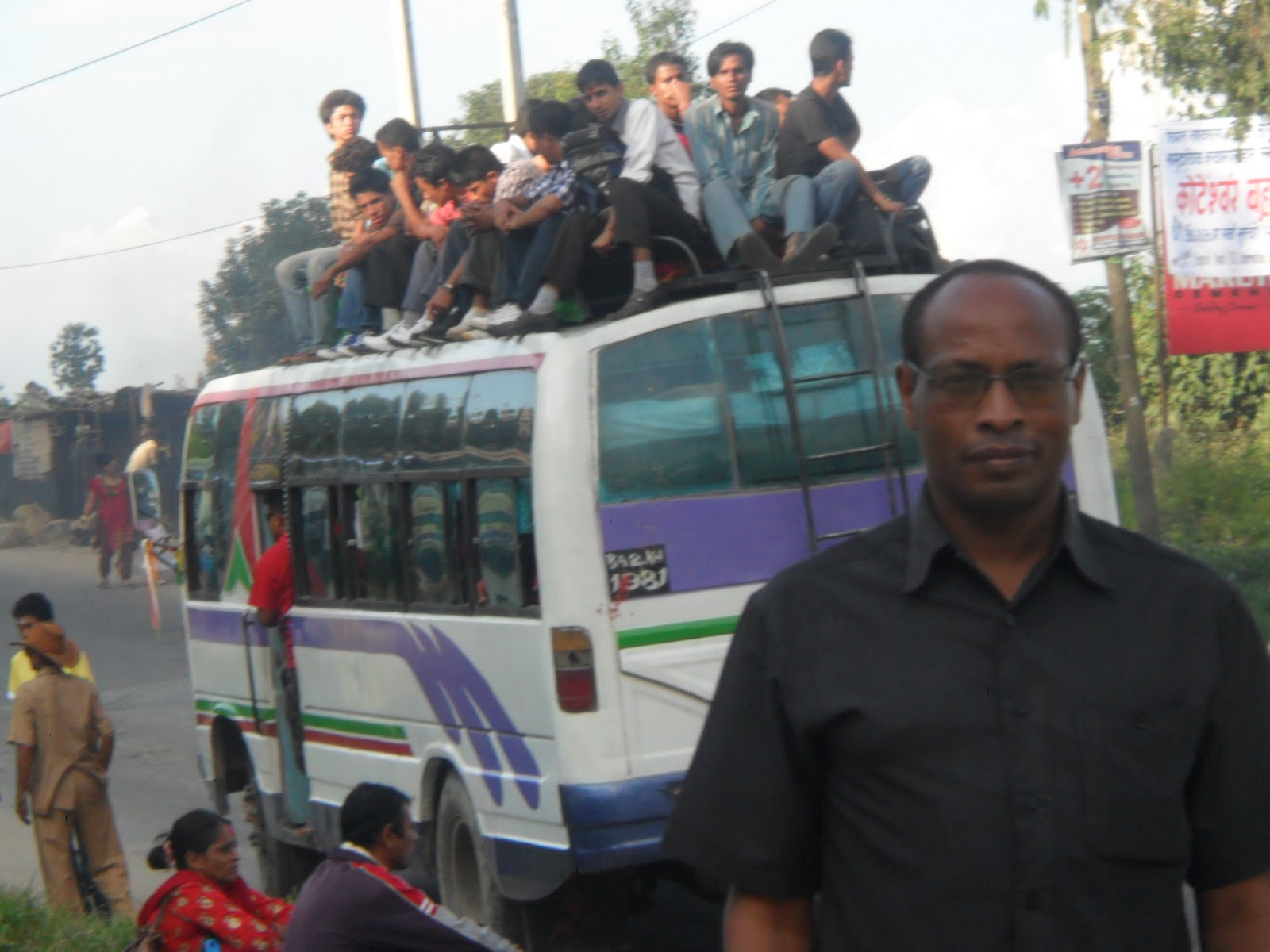
Dashain is also about family respect, so that is why scattered families come together. Cities suddenly seems to empty, more people returning to villages than people joining families in cities. During this season, people rush to book tickets on buses or planes.
Everybody tries to get home to see familiy

Children love the season also for flying kites and if you visit Kathmandu or any other city during this season, the day-sky is filled with colorful kites like shinning stars in the night!

Tika is a symbol on the forehead that the deity being worshipped is given the highest honor by the person wearing it. Getting a tika is also thought to be a blessing. The oldest person in the family begins giving Dashain tika to the youngest then the second youngest in the family and so on. There is a Hindu belief that 'faith', 'hope', 'inspiration' and 'blessings', all come alive in Dashain.

Traditionally, popular Dashain bank notes are Rupees 2, 5, 10, and 25. Therefore receiving a tika and offering money in notes is regarded as an appreciation. Everybody tries to get smaller and new notes, so banks are usually busy during the season.
The houses and temples are decorated. Walls get a new coat of paints, roads are cleaned, homes and temples are decorated with lights, villagers join together to clean or build new trails, paint their homes using red-colored mud. People clean themselves mentally too by visiting various temples and worshiping during the festival. Puja is regarded as worshiping god for peace and prosperity and are performed at the end of Dashain. Playing cards is a popular during Dashain. Usually family members play cards with each-other or with friends for money.

Village children ride on Ferris wheels, and swings built using traditional methods (ropes made from tough grass, bamboo sticks and wood). Commercial fairs and celebration events are organised in cities.

Some Christian visit their families but do not participate in eating the food sacrificed or receive the tika that shows participation in Hindu worship. Other Christians use it as an opportunity to encourage, train and coach new believers.


Pray for :

- Christian communities and leaders in Nepal

- Christian believers who face persecution from their families

- Organisations including UMN that are focused on development and anti-trafficking

- Nepal peace process and drafting of the new constitution

- Nepal security situation - there has been increase of petty criminal activities

Monday, 19 September 2011

6.8 quake hits Nepal and five lose lives in Kathmandu and Sunsari

An earthquake measuring 6.8 Richter scale jolted Nepal on Sunday, 18th September 2011 at 6.25 pm. It was the strongest quake to hit the country in 73 years. The epicenter was between Taplejung in Eastern Nepal and the India state of Sikkim. There were 14 aftershocks of varying magnitude that were recorded. The number of casualties and extent of damage is still to be ascertained. However the Nepal home affair ministry had reported that 60 people were injured in a stampede whilst jumping off the building in Kathmandu. Three people died after the compound wall of the British Embassy collapsed in the aftermath of the quake.
The parliament session stalled 15 minutes after lawmakers rushed out of the the parliament building when the strong earthquake hit. 

My family was safe and we thank God for protection. Let’s remember to pray for families whose houses were damaged and those who lost their dear ones and friends.

Tuesday, 13 September 2011

When children live positively

In Nepal, some children are not spared HIV due to infection spread by migrant workers. A child is born with HIV virus because the family could not afford to meet their basic needs.  It happened because the father decided to go to India to look for a job and while there he was infected with HIV.  On his return it was transmitted to his wife and finally to the unborn child. 

According to a report published by the United Nations, labour migrants make up 41 percent of the total known HIV infections.  Nowadays people are more aware about HIV compared to the situation 10 years ago and the stigma faced by people living with HIV has decreased.  But no significant progress has been made when it comes to containing the incidence of HIV brought by migrant workers. UMN will expand its HIV work to focus more on migrants. The community’s capacity to reduce the impact of HIV will be developed and this will give hope to the affected people. If families are able to meet their needs then children’s lives will be protected. There are other cases of children who suffer silently and, because sufficient stigma still persists, the family is afraid to go for treatment, care and support. What kills is the stigma! 

Nepal has wonderful children

Pray for:
·        Children who are infected and affected by HIV
·        Migrant workers that God protect them
·        Female community health volunteers who are supporting  the needy children
·        Communities to protect the rights of children